











logo
Solusi
0+
Negara di seluruh dunia
0+
Mitra
0+
paten
0+
Karyawan
Acara perusahaan
Why Can a VFD Overheat Even When the Motor Current Is Normal? Understanding Carrier Frequency, Ambient Temperature Why Can a VFD Overheat Even When the Motor Current Is Normal? Understanding Carrier Frequency, Ambient Temperature When a variable frequency drive reports an overtemperature alarm, the first reaction is often to check whether the motor current has exceeded the VFD’s rated current. High output current can certainly increase heat generation. However, a VFD may still overheat even when the displayed motor current appears normal. This is because the drive’s internal temperature is affected by many factors other than motor current. Carrier frequency, ambient temperature, cabinet ventilation, cooling fan condition, dust accumulation, installation spacing, altitude, and load cycle can all influence the temperature of the power components. Understanding these factors helps engineers identify the real cause of overheating instead of simply replacing the VFD with a larger model. Where Does Heat Inside a VFD Come From? A VFD contains rectifier components, a DC bus, capacitors, power semiconductor modules, control circuits, and cooling components. During operation, current passing through the rectifier and power modules creates conduction losses. At the same time, the output semiconductor devices switch on and off rapidly to generate the PWM waveform required to control the motor. Every switching event produces a small amount of energy loss. The heat generated by a single event may be limited, but thousands of switching events occur every second. The accumulated switching loss can therefore become an important part of the VFD’s internal heat. Additional heat may also come from the charging circuit, DC bus components, internal braking unit, control power supply, and surrounding equipment inside the electrical cabinet. Why Does Carrier Frequency Affect VFD Temperature? Carrier frequency determines how frequently the VFD’s output semiconductor devices switch. A higher carrier frequency can reduce audible motor noise and may improve the smoothness of the motor current waveform. For this reason, some users increase the carrier frequency when the motor produces an obvious high-frequency sound. However, increasing the carrier frequency also increases the number of switching events per second. More switching events generally mean higher switching losses and additional heat inside the VFD. The motor current may remain below the rated value while the VFD temperature continues to rise. In this situation, the current display alone does not show the complete thermal condition of the drive. Carrier frequency should therefore be selected according to the motor, application, cable length, noise requirements, ambient temperature, and VFD manufacturer’s recommendations. Setting it unnecessarily high may reduce the available output capacity or require derating. How Does Ambient Temperature Affect Cooling? A VFD transfers heat from its power components to a heat sink and then releases that heat into the surrounding air. If the air entering the VFD is already hot, the temperature difference between the heat sink and the surrounding environment becomes smaller. The cooling system can no longer remove heat as effectively. This situation is common in enclosed control cabinets, outdoor installations exposed to sunlight, factories with ovens or heating equipment, and environments where several high-power devices are installed close together. The temperature inside an electrical cabinet can be significantly higher than the room temperature. Measuring only the workshop temperature may therefore lead to an incorrect conclusion. The temperature should be checked near the VFD’s air inlet under actual operating conditions. Why Is Cabinet Ventilation Important? A cooling fan can move air only when there is a clear path for airflow. If the cabinet inlet, outlet, filter, or VFD air duct is blocked, hot air may circulate inside the cabinet instead of being discharged. Common installation problems include: · Insufficient clearance above or below the VFD · Several VFDs installed too closely together · Hot air from a lower drive entering the drive above it · Cabinet air inlets that are too small · Incorrect fan direction · Dust-clogged filters or heat sinks · Cables blocking the VFD ventilation path · Cabinet doors kept closed without sufficient ventilation In dusty environments, filters and heat sinks require regular inspection and cleaning. A filter may appear acceptable from the outside while its internal airflow has already been significantly reduced. Can a Cooling Fan Cause Intermittent Overheating? Yes. A cooling fan may still rotate but no longer provide sufficient airflow because of bearing wear, dust, reduced speed, or unstable power supply. This can create intermittent overheating. The VFD may operate normally when the load or ambient temperature is low but report an overtemperature alarm during longer production cycles or warmer periods. Maintenance personnel should check not only whether the fan rotates, but also whether the airflow is strong and stable. Fan operating time and replacement recommendations should also be considered. Why Does Altitude Require Derating? At higher altitudes, air density decreases. Lower air density reduces the amount of heat that can be removed by the same airflow. Even if the ambient temperature is not particularly high, a VFD operating at high altitude may have lower cooling capacity than the same model installed near sea level. The insulation and cooling requirements of electrical equipment can also change with altitude. When an installation exceeds the manufacturer’s standard operating altitude, the applicable derating requirement should be confirmed. What Does VFD Derating Mean? Derating means operating the VFD below its nominal output capacity when environmental or operating conditions are more demanding than the standard rated conditions. Derating may be required because of high ambient temperature, high altitude, elevated carrier frequency, demanding load cycles, or installation inside a poorly ventilated cabinet. For example, a VFD with a certain rated current under standard conditions may need to operate at a lower continuous output current in a hot environment. Alternatively, a higher-power VFD may be selected to provide sufficient thermal margin. Derating is not an indication that the VFD is defective. It is an engineering method used to maintain reliability and service life under non-standard conditions. How Should an Overheating Problem Be Investigated? When a VFD reports an overtemperature alarm, engineers should check: · Actual output current and load cycle · Ambient temperature near the VFD air inlet · Cabinet internal temperature · Carrier frequency setting · Cooling fan operation and airflow · Heat sink and filter cleanliness · Installation clearance · Cabinet inlet and exhaust design · Altitude · Nearby heat-producing equipment · Frequency and duration of acceleration, deceleration, and braking The alarm history should also be reviewed. If overheating occurs only at a particular time of day, production stage, or load condition, that pattern may help identify the cause. Using VEIKONG VFDs in High-Temperature Applications VEIKONG provides VFD solutions for a wide range of industrial motor applications. Correct selection, installation, ventilation, parameter settings, and maintenance are essential for reliable operation. For applications involving high ambient temperatures, enclosed cabinets, high altitude, elevated carrier frequency, or continuous heavy loads, customers should provide the relevant operating conditions during product selection. VEIKONG’s sales and engineering teams can help evaluate the application, recommend a suitable model, and determine whether additional power margin or derating should be considered. A normal motor current reading does not always mean that the VFD’s thermal condition is normal. By examining the complete cooling environment and operating conditions, engineers can solve overheating problems more accurately and protect the long-term reliability of the drive system. Related words: VFD overtemperature alarm VFD carrier frequency and heat VFD derating in high ambient temperature
2026-09-22 19:36:37 More >
Why Does Motor Cable Length Matter in VFD Systems? Understanding Reflected Voltage and Output Protection Why Does Motor Cable Length Matter in VFD Systems? Understanding Reflected Voltage and Output Protection When installing a variable frequency drive, engineers often pay close attention to the motor power, voltage, current, and load type. However, the distance between the VFD and the motor is sometimes treated as a secondary detail. In reality, motor cable length can significantly affect the electrical behavior of a VFD system. When the cable becomes long, the motor terminals may experience higher voltage stress, increased electromagnetic interference, leakage current, and other problems that are not obvious from the motor nameplate. Understanding these effects can help engineers select suitable cables, plan the installation correctly, and determine whether an output reactor, dV/dt filter, or sine wave filter is required. Why Is a VFD Output Different from a Normal Power Supply? A VFD does not produce a perfectly smooth sinusoidal voltage directly. Its power semiconductors switch the DC bus voltage rapidly to create a pulse-width-modulated output, commonly known as PWM. The motor current may remain relatively smooth because the motor windings have inductance. However, the voltage waveform traveling through the cable consists of fast switching pulses with steep voltage edges. When the VFD is installed close to the motor, these pulses usually reach the motor with limited cable-related distortion. As the cable becomes longer, its electrical characteristics become more important. The cable begins to behave like a transmission line rather than a simple conductor. How Does Reflected Voltage Occur? The VFD cable and motor do not always have the same electrical impedance. When a fast voltage pulse reaches the motor terminals, part of the pulse may be absorbed by the motor, while another part may be reflected toward the drive. The reflected pulse can combine with the incoming pulse and temporarily increase the voltage at the motor terminals. This phenomenon is often called reflected-wave voltage or reflected voltage. The amount of voltage stress depends on several factors, including cable length, cable type, motor impedance, system voltage, PWM rise time, carrier frequency, grounding, and motor insulation design. Therefore, there is no single cable length that is considered “long” for every VFD installation. Repeated voltage peaks may gradually weaken motor winding insulation. Older motors or motors not designed for inverter operation may be more sensitive to this stress, especially in higher-voltage systems. What Other Problems Can Long Motor Cables Cause? Reflected voltage is not the only concern. A long cable also introduces additional capacitance between phases and between the conductors and ground. Every time the VFD output switches, this capacitance must be charged and discharged. The resulting high-frequency current can increase stress on the drive output, contribute to leakage current, and create electromagnetic interference. Possible symptoms include: · Unexpected overcurrent or ground-fault trips · Increased motor noise or vibration · Interference with sensors, communication cables, or nearby equipment · Higher common-mode current · Motor bearing current · Increased motor temperature · Instability during operation at certain frequencies These symptoms do not automatically prove that cable length is the only cause. Grounding, shielding, motor condition, parameter settings, cable routing, and installation quality should also be checked. How Should Motor Cables Be Installed? Cable selection and installation are the first line of protection. A cable suitable for inverter duty is generally preferred, particularly when the motor cable is long or the surrounding environment is sensitive to electrical interference. The cable shield should be properly terminated according to the system design. Ground connections should be short, secure, and designed to provide a low-impedance path for high-frequency current. Motor cables should be separated from signal cables, encoder cables, communication wiring, and low-voltage control circuits. If power and signal cables must cross, crossing them at approximately 90 degrees can help reduce interference. The cable route should also be planned carefully. Coiling unnecessary cable length can increase inductive and capacitive effects and should generally be avoided. When Is an Output Reactor Used? An output reactor is installed between the VFD and the motor. It adds inductance to the output circuit and can reduce current ripple, limit rapid current changes, and decrease some of the electrical stress caused by the cable. For moderate cable lengths, an output reactor may provide sufficient improvement. It can also help protect the drive when the motor or cable creates a demanding output condition. However, an output reactor does not produce a sinusoidal waveform and may not fully control reflected voltage in every long-cable application. Its suitability should be evaluated according to the VFD, motor, cable length, voltage level, and operating frequency. What Is the Difference Between a dV/dt Filter and a Sine Wave Filter? A dV/dt filter is designed to reduce the rate of voltage change and limit voltage peaks reaching the motor. It is commonly considered when motor cable length or motor insulation stress exceeds what can be handled by basic output protection. A sine wave filter provides a higher level of filtering. It converts the PWM output into a waveform that is much closer to a sinusoidal voltage before it reaches the motor. Sine wave filters may be used for very long motor cables, sensitive motors, applications requiring lower motor noise, or installations where the motor is located far from the control equipment. They are larger and more expensive than output reactors and must be correctly matched to the VFD and operating frequency. How Should Engineers Evaluate a Long-Cable Application? Before installation, engineers should confirm: · VFD output voltage and power · Motor type and insulation condition · Actual distance between the VFD and motor · Cable type, shielding, and routing · Carrier frequency · Maximum operating frequency · Grounding method · Environmental and electromagnetic compatibility requirements The VFD manufacturer’s cable-length recommendations should always be reviewed. If the application exceeds the recommended conditions, the appropriate output protection should be confirmed before commissioning. Applying VEIKONG VFDs in Long-Cable Systems VEIKONG provides variable frequency drives for pumps, fans, compressors, lifting equipment, production machinery, and other industrial applications. When applying a VEIKONG VFD in a system with a long motor cable, customers should provide the motor parameters, voltage, cable length, application type, and installation conditions. Our sales and engineering teams can help evaluate the application and determine whether additional output protection should be considered. Correct cable planning and output protection can reduce electrical stress, improve motor reliability, minimize interference, and support more stable operation throughout the service life of the system.   Related words: VFD motor cable length Reflected voltage in VFD systems VFD output reactor and dV/dt filter
2026-09-22 19:34:05 More >
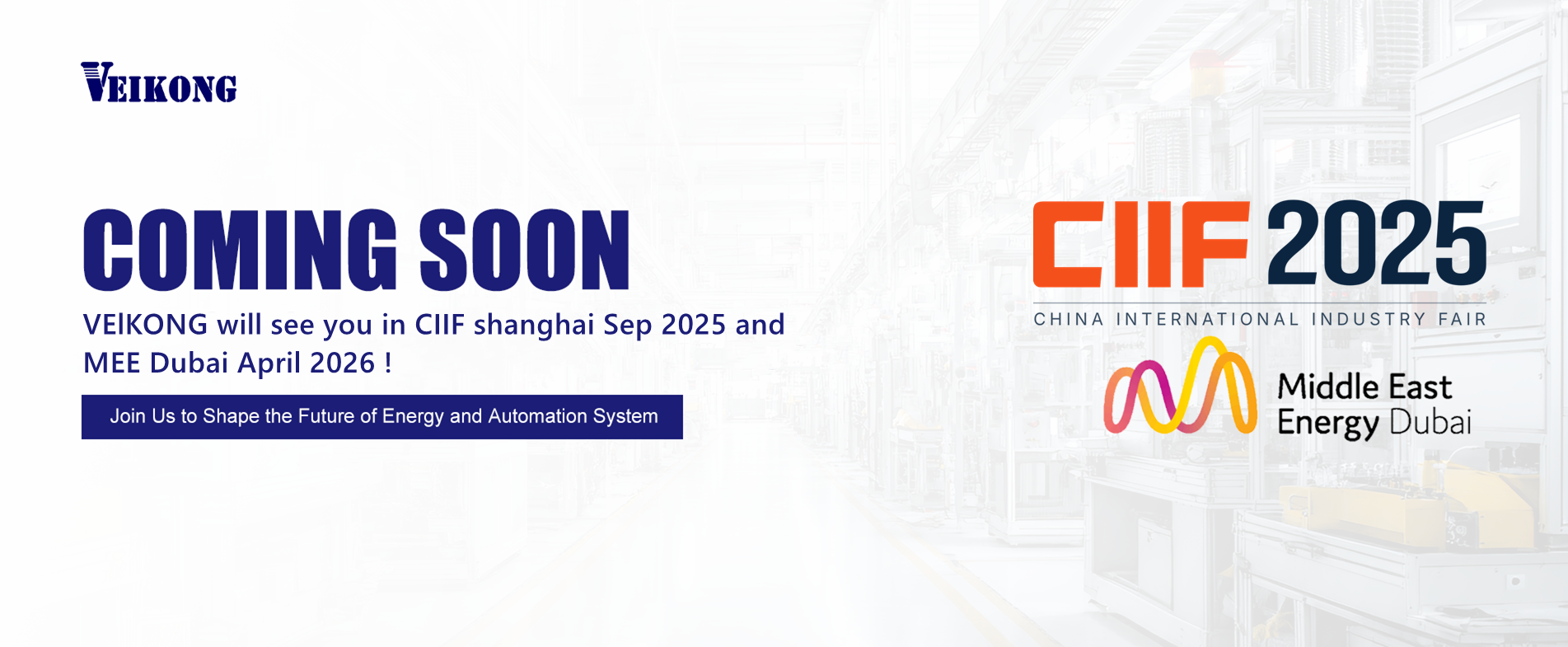
Meet VEIKONG at CIIF 2026: Reliable VFD and Industrial Drive Solutions in Shanghai Meet VEIKONG at CIIF 2026: Reliable VFD and Industrial Drive Solutions in Shanghai VEIKONG is pleased to announce that we will participate in the China International Industry Fair 2026, which will be held from October 12 to 16, 2026, at the National Exhibition and Convention Center in Shanghai, China. This will be VEIKONG’s first appearance at CIIF under our own brand, representing an important step in strengthening our presence in the industrial automation market. We warmly invite customers, distributors, system integrators, equipment manufacturers, and industry professionals to visit us at Hall 8.1, Booth F128.   At the exhibition, visitors will have the opportunity to explore VEIKONG’s latest variable frequency drives, specialized motor control solutions, soft starters, and related industrial automation products.   Exhibition Information Date: October 12–16, 2026 Venue: National Exhibition and Convention Center, Shanghai, China Hall: 8.1 Booth: F128   Discover VEIKONG’s Industrial Drive Solutions Modern industrial equipment requires more than simple motor speed adjustment. Different machines have different requirements for starting torque, speed accuracy, overload capacity, communication, braking, protection, and environmental adaptability. At CIIF 2026, VEIKONG will present a selection of drive solutions developed for a wide range of industrial applications. Our product portfolio includes general-purpose variable frequency drives, high-performance vector drives, lifting application drives, solar pump inverters, high-protection solutions, soft starters, and supporting accessories. These products can be considered for applications such as pumps, fans, air compressors, lifting equipment, textile machinery, packaging machines, woodworking equipment, CNC machines, conveyors, logistics systems, and other motor-driven equipment. Rather than recommending the same product for every project, the VEIKONG team evaluates the motor parameters, power supply, load characteristics, control requirements, installation environment, and operating conditions before proposing a suitable solution.   Face-to-Face Technical Communication One of the most valuable parts of an industrial exhibition is the opportunity to discuss real applications directly with customers and engineers. At the VEIKONG booth, visitors can bring information about their motors, machines, current drive systems, or new projects. Our team will be available to discuss topics such as VFD model selection, motor compatibility, voltage and power requirements, overload capacity, braking solutions, communication functions, parameter settings, and system configuration. For specialized applications, customers can also communicate with us about lifting control, multi-motor coordination, solar water pumping, high-frequency motor operation, constant-pressure water supply, and other application requirements. These discussions help both sides move beyond basic catalogue specifications. By understanding the actual working conditions, we can provide recommendations that are more relevant to the customer’s equipment and reduce potential problems during installation and commissioning.   Reliable Products Supported by Testing Reliability is one of the most important considerations when choosing an industrial drive. A VFD may operate continuously for long periods and may face changing loads, high temperatures, dust, voltage fluctuations, or demanding acceleration and deceleration cycles. VEIKONG pays close attention to product testing and quality control. Before delivery, our products undergo multiple inspection and testing procedures according to the product type and power range. The purpose is to verify basic functions, output performance, protection functions, and operating stability before the equipment reaches the customer. At CIIF 2026, visitors can examine the products directly and learn more about their structure, keypad options, control functions, communication capabilities, protection features, and application positioning.   Technical Support Beyond Product Delivery Industrial automation products often require professional support throughout the project. Correct selection and parameter configuration are just as important as the hardware itself. VEIKONG provides support during both the pre-sales and after-sales stages. Before an order, our sales and engineering teams can help customers confirm product selection based on the motor information and application conditions. After delivery, we can assist with parameter settings, installation questions, commissioning, troubleshooting, and other technical issues. This support is particularly important for customers using a new product series or applying a VFD to specialized equipment for the first time. Clear communication can help shorten the commissioning process and reduce unnecessary trial and error.   Cooperation Opportunities for Global Partners CIIF 2026 will also provide an opportunity for VEIKONG to meet distributors, automation companies, panel builders, system integrators, and equipment manufacturers seeking long-term cooperation. In addition to standard products, visitors can discuss OEM and ODM requirements, logo and label customization, keypad options, product documentation, communication functions, accessories, and market development plans with our team. VEIKONG has served customers in different international markets and understands that each region may have different voltage standards, application habits, certification requirements, service expectations, and market positioning. We aim to build practical partnerships based on suitable products, responsive communication, and long-term technical support.   Visit VEIKONG at Hall 8.1, Booth F128 CIIF 2026 will be an important opportunity for VEIKONG to present our products, exchange application experience, listen to market feedback, and establish new partnerships. Whether you are looking for a VFD for a specific machine, evaluating a new industrial drive supplier, developing your own automation product line, or searching for a reliable long-term manufacturing partner, we welcome you to visit our booth and speak with our team. Meet VEIKONG at the National Exhibition and Convention Center in Shanghai from October 12 to 16, 2026. We look forward to welcoming you at Hall 8.1, Booth F128 and exploring new possibilities in industrial automation together.   Related words: CIIF 2026 Shanghai industrial variable frequency drive manufacturer VEIKONG VFD solutions
2026-09-20 17:43:59 More >
VEIKONG at Middle East Energy Dubai 2026: Strong Connections, Valuable Feedback, and New Opportunities VEIKONG at Middle East Energy Dubai 2026: Strong Connections, Valuable Feedback, and New Opportunities From September 1 to 3, 2026, VEIKONG participated in Middle East Energy Dubai at the Dubai World Trade Centre. During the three-day exhibition, our team welcomed visitors at Booth H7.C37 and presented a range of motor control and energy-saving solutions for industrial and solar-powered applications. Middle East Energy Dubai provided VEIKONG with a valuable opportunity to meet customers, distributors, system integrators, and industry professionals face to face. More importantly, the conversations at our booth helped us better understand current market requirements across the Middle East and other international markets. A Product Line Designed for Different Applications At the exhibition, VEIKONG introduced visitors to several of our core product lines, including solar pump inverters, high-performance variable frequency drives, high-end VFD solutions, and soft starters with built-in bypass. The products displayed at the booth represented different levels of industrial motor control requirements. Some visitors were looking for economical and practical solutions for pumps, fans, compressors, and general machinery, while others focused on more demanding applications requiring stronger motor control performance, flexible parameter settings, communication functions, or higher power ranges. Solar pump inverter solutions also attracted considerable attention. Visitors discussed applications such as agricultural irrigation, water supply, livestock watering, and remote pumping systems where access to the conventional power grid may be limited or costly. These discussions showed that customers are not simply searching for a single inverter model. They need a complete and suitable solution based on the local power supply, motor parameters, pump specifications, solar panel configuration, environmental conditions, and system operating requirements. What Customers Focused on at the Exhibition Product price remains important, but our conversations in Dubai showed that professional buyers are also paying close attention to long-term reliability and technical support. Many visitors wanted to understand how a VFD would perform under actual working conditions rather than only comparing the specifications shown in a catalogue. Their questions covered motor compatibility, input voltage, output performance, overload capacity, protection functions, communication methods, parameter settings, and product selection. For solar pumping applications, customers were particularly interested in MPPT performance, solar DC input voltage, AC and DC power switching, low-light operation, system protection, and compatibility with different pump types. For industrial VFDs and soft starters, the discussions focused on stable motor operation, smooth starting, energy efficiency, maintenance requirements, and suitability for specific machines. This practical feedback is highly valuable to VEIKONG. It helps us understand what international customers truly need and allows our engineering and sales teams to provide more accurate recommendations instead of offering a general product without considering the application. Positive Feedback on Products and Support Visitors responded positively to VEIKONG’s broad product range and the clear presentation of different solutions at the booth. The opportunity to examine the products directly also helped customers better understand their structure, size, keypad design, and application positioning. Another important point raised during the exhibition was technical communication. Industrial products often require more than a quotation and a user manual. Customers may need assistance with model selection, parameter configuration, installation, commissioning, troubleshooting, or special applications. Our team explained that VEIKONG provides both pre-sales application support and after-sales technical assistance. Before an order, we can help check motor information and working conditions to recommend a suitable model. After delivery, our sales and engineering teams remain available to support product setup and solve technical questions. For distributors and companies developing their own brands, visitors also discussed OEM cooperation, branding options, product documentation, market development, and the possibility of building a long-term product portfolio. More Than an Exhibition For VEIKONG, participating in Middle East Energy Dubai 2026 was not only about displaying products. It was an opportunity to listen, learn, and build stronger connections with the market. The face-to-face discussions gave us a clearer view of regional demand for solar water pumping, industrial automation, motor energy-saving solutions, and reliable power control products. They also helped us identify new opportunities for distributor cooperation, project support, and customized solutions. Every conversation contributes to our future product development and service improvement. The feedback collected during the exhibition will help VEIKONG continue refining product performance, application support, documentation, and communication with international customers. Moving Forward Together We sincerely thank everyone who visited the VEIKONG booth during Middle East Energy Dubai 2026. Whether you came to explore a specific project, compare technical solutions, discuss distribution cooperation, or learn more about our company, we greatly appreciate your time and interest. For visitors who have already shared project information with us, our team will continue following up with product selections, technical details, quotations, and other required materials. Customers who were unable to meet us during the exhibition are also welcome to contact VEIKONG for more information. VEIKONG remains committed to providing reliable solar pump inverters, variable frequency drives, soft starters, and professional motor control solutions for customers worldwide. We look forward to turning the connections established in Dubai into practical cooperation and long-term partnerships. Related words: Middle East Energy Dubai 2026 Solar pump inverter manufacturer VEIKONG industrial VFD solutions
2026-09-08 17:58:28 More >
Selamat datang untuk mengirim pertanyaan
Silakan komunikasikan kebutuhan Anda untuk produk melalui formulir komunikasi online kami akan membalas dengan quatiation lebih cepat di Email dan seluler
Kami tetap bekerja online, berhubungan.
+86 139 2373 6332 (WhatsApp)
Terry.lee@veikong.com
Lantai 4, Gedung 5, Industri Dongluyang, Taman, No. 4, Jalan Tengfeng 4, Fuyong Phoenix Ketiga, Zona Industri, Distrik Baoan, Shenzhen Cina